Why Calendar Invites Are the Backbone of Professional Meetings
In today’s fast-paced professional meetings environment, meetings are no longer just internal discussions,they drive sales, marketing campaigns, partnerships, and customer relationships. At the center of all these interactions lies a simple yet powerful tool: the calendar invite. To understand its importance, it’s worth asking what is calendar invite is in practical terms. It is not just a notification, it is a structured way to ensure that the right people show up at the right time with the right context.
As teams grow, the number of meetings, webinars, and events increases rapidly. Many organizations still rely on manual coordination, sending emails, following up, and reminding attendees. At first, this may seem manageable. But as scale increases, inefficiencies start to surface. Teams begin searching for answers like how to send a calendar invite or trying to send calendar invite outlook more effectively, which indicates a deeper challenge: the lack of a scalable scheduling system.
The impact is significant. Missed meetings, low attendance, and confusion around event details become common. This is why calendar invites are not just helpful, they are the backbone of professional meetings.
The Challenges of Manual Scheduling
Manual scheduling may work for small teams, but it quickly becomes a bottleneck as operations scale. In most organizations, scheduling involves drafting emails, copying event details, and manually adding attendees. Teams often rely on tools like Outlook or Gmail, leading them to search for solutions such as how to send invitation on outlook or how to send calendar invite gmail. While these methods solve basic needs, they do not address scalability.
Consider a marketing team organizing a webinar for 2,000 attendees. The process of manually sending invites or relying on email communication becomes overwhelming. Even when attempting to send invite through standard tools, there is no guarantee that attendees will receive, open, or act on it. The use case clearly shows that manual processes are not designed for high-volume operations.
The impact is immediate and measurable. Teams spend excessive time on repetitive tasks, errors creep into invites, and attendees often miss events due to lack of proper reminders. This creates frustration not only for the organizers but also for the participants.
The Hidden Costs of Manual Scheduling
The real problem with manual scheduling is not just inefficiency,it’s the hidden cost that accumulates over time. One of the biggest costs is time. Teams spend hours managing invites, following up with attendees, and correcting mistakes. This time could otherwise be spent on strategic activities like improving event content or engaging with customers.
In a real-world use case, a sales team managing multiple client meetings daily may rely on manual processes. If even a few meetings are missed due to scheduling errors, the impact can be significant in terms of lost revenue. Similarly, for webinar teams, low attendance directly affects campaign performance and ROI.
Another hidden cost is operational complexity. Without a structured system, teams struggle to manage updates, cancellations, and changes. For example, if a conference session time changes, updating all attendees manually becomes nearly impossible. The impact is confusion, reduced trust, and a poor attendee experience.
Finally, there is the cost of brand perception. A disorganized invite process reflects poorly on the organization. Clients and attendees expect professionalism, and any gaps in communication can damage credibility.
Why Calendar Invites Are the Backbone of Professional Meetings
Calendar invites solve many of the challenges associated with manual scheduling by providing a centralized and structured approach. Unlike emails, which can be ignored or lost, calendar invites ensure that events are directly added to the attendee’s schedule. This creates a single source of truth for all meeting details.
In a typical use case, a team sending invites through a calendar system ensures that attendees receive automatic reminders, correct timings, and all necessary information in one place. This reduces the chances of missed meetings and improves overall coordination.
The impact is clear. Meetings become more reliable, attendance improves, and teams can focus on delivering value rather than managing logistics. Calendar invites transform scheduling from a manual task into a streamlined process.
How to Send Calendar Invites Using Outlook and Gmail
For many professionals, the first step in scheduling is learning how to use existing tools. Questions like how to send calendar invite gmail or send calendar invite outlook are common. In Outlook, users typically create a meeting, add attendees, and send the invite. Similarly, Gmail allows users to create events through Google Calendar and share them with participants.
While these methods work for small-scale scenarios, they reveal limitations when applied to larger use cases. For example, a team trying to send multiple calendar invites for recurring sessions may find themselves repeating the same steps multiple times. This not only increases effort but also introduces the risk of inconsistencies.
The impact becomes more evident as the number of events grows. Teams struggle to maintain accuracy, manage updates, and ensure that all attendees are properly informed. This highlights the need for a more scalable solution.
Scaling Scheduling with Bulk Calendar Invites
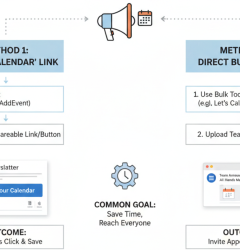
As organizations grow, the ability to manage bulk calendar operations becomes essential. Instead of handling invites individually, teams need systems that allow them to send mass calendar invites efficiently. This is where concepts like bulk calendar invite and send bulk calendar invite come into play.
In a practical use case, a webinar team hosting multiple sessions for thousands of attendees cannot rely on manual processes. They need a way to manage calendars bulk and ensure that each attendee receives the correct invite. Without this capability, the process becomes unmanageable.
The impact of adopting bulk scheduling is transformative. Teams can save time, reduce errors, and ensure consistent communication. More importantly, they can scale their operations without increasing manual effort.
Custom Calendar Bulk: Personalization at Scale
While bulk scheduling solves the problem of volume, personalization is equally important. This is where custom calendar bulk comes into play. Instead of sending generic invites, teams can tailor each invite to the specific needs of the attendee.
For example, a conference with multiple tracks may require sending different session invites to different groups of attendees. Using custom calendar bulk, organizers can ensure that each participant receives relevant information. This enhances the attendee experience and increases engagement.
The impact is significant. Personalized invites lead to higher attendance rates, better engagement, and a more professional experience. It also allows teams to manage complex event structures with ease.
Bulk Meeting Invites for Webinars, Events, and Client Meetings
Different teams have different scheduling needs, but the requirement for efficiency remains constant. Webinar teams need to manage large audiences, sales teams need to coordinate client meetings, and event teams need to handle multi-session conferences.
In each of these use cases, the ability to manage bulk meeting invite processes is crucial. For instance, a sales team scheduling demos for multiple clients can benefit from automation to ensure that invites are sent accurately and on time. Similarly, event teams can use send multiple calendar invites to manage different sessions seamlessly.
The impact of using bulk invite systems is improved efficiency, reduced manual workload, and better overall coordination. Teams can focus on their core objectives instead of being bogged down by administrative tasks.
How Let’s Calendar Simplifies Professional Scheduling
This is where Let’s Calendar becomes a game-changer for growing teams. Instead of relying on manual processes or limited tools, teams can use a centralized platform to manage all their scheduling needs.
In a real-world use case, a marketing team running a large webinar campaign can use Let’s Calendar to send invites to thousands of attendees effortlessly. There is no need to repeatedly search for solutions like how to send a calendar invite or struggle with traditional tools. The platform enables teams to handle everything from invite creation to delivery and tracking.
The impact is immediate. Teams save time, reduce errors, and improve attendance rates. They also gain better visibility into attendee responses, allowing them to optimize future events. By automating scheduling, Let’s Calendar helps organizations scale their operations without increasing complexity.
Best Practices for Professional Scheduling
As teams adopt modern scheduling solutions, it becomes important to follow best practices that maximize efficiency. Prioritizing calendar-based communication over email ensures better visibility and engagement. Using automation for bulk operations eliminates repetitive tasks and reduces errors.
In a practical use case, a team that adopts these practices can manage large-scale events with ease. Instead of struggling with manual processes, they can focus on delivering high-quality experiences for their audience. The impact is improved productivity, better coordination, and more successful events.
Conclusion
Calendar invites are more than just a scheduling tool, professional meetings, they are the foundation of effective professional communication. As teams grow, the limitations of manual scheduling become increasingly apparent. From time loss and operational inefficiencies to missed opportunities and poor attendee experiences, the hidden costs are too significant to ignore.
By adopting structured and automated solutions, organizations can overcome these challenges and unlock new levels of efficiency. Tools like Let’s Calendar enable teams to manage scheduling at scale, ensuring that every meeting, webinar, and event runs smoothly.
In the end, the question is not just how to schedule meetings, but how to do it in a way that supports growth, improves outcomes, and delivers a seamless experience for everyone involved.






Shubhi Patel